
One of those historical events that influenced not just a country but the entire world was the Korean War. In an attempt to unite the entire peninsula under their control, North Korean troops invaded the South on June 25, 1950, crossing the 38th parallel (the line that divided North and South Korea after WWII)). Seoul, the capital, fell in three days, and for a brief period, it appeared as if the entire South might be lost. However, what took place was a three-year war that attracted nations from all over the world and ended on July 27, 1953, a date that is still secret.
After decades of Japanese occupation, Korea was abruptly split between two new powers at the end of World War II in 1945. The United States favored the south, while the Soviet Union supported the north. The peninsula came to stand for Cold War conflict as each side established its own government. When the North attacked in 1950, tensions had escalated to the point where one of the bloodiest wars of the 20th century broke out.
The United Nations quickly stepped in to support South Korea, with the United States playing a major role. Over 15 countries provided supplies, medical personnel, and troops. The combined forces succeeded in driving the North back for a while, even making progress near the Chinese border. However, when China sent hundreds of thousands of troops into the conflict in October 1950, it took a drastic turn. The fighting turned into a vicious back-and-forth conflict as the battlefield changed once more. Neither side managed to win by a substantial amount.
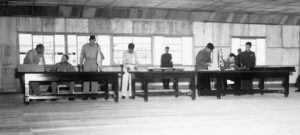
The war came to a halt in 1951. The battles went on intensely but the front lines hardly moved. Panmunjom (a small village on the border where North and South Korea signed the ceasefire in 1953)
marked the start of negotiations, but they took more than two years to complete. The problem of prisoners of war was one of the main causes. The United Nations backed the decision of many Chinese and North Korean soldiers who had been captured to remain in the South or relocate because they did not want to go back home. This delayed any agreement and annoyed and frustrated the North. Civilians suffered the most during this period. In an attempt to get away from the front lines, families walked for days while carrying their kids hoping to escape the front lines (the areas where opposing armies faced each other). Villages were burned, towns destroyed, and entire generations were displaced. The war was no longer only about soldiers and borders it became about survival for ordinary people.
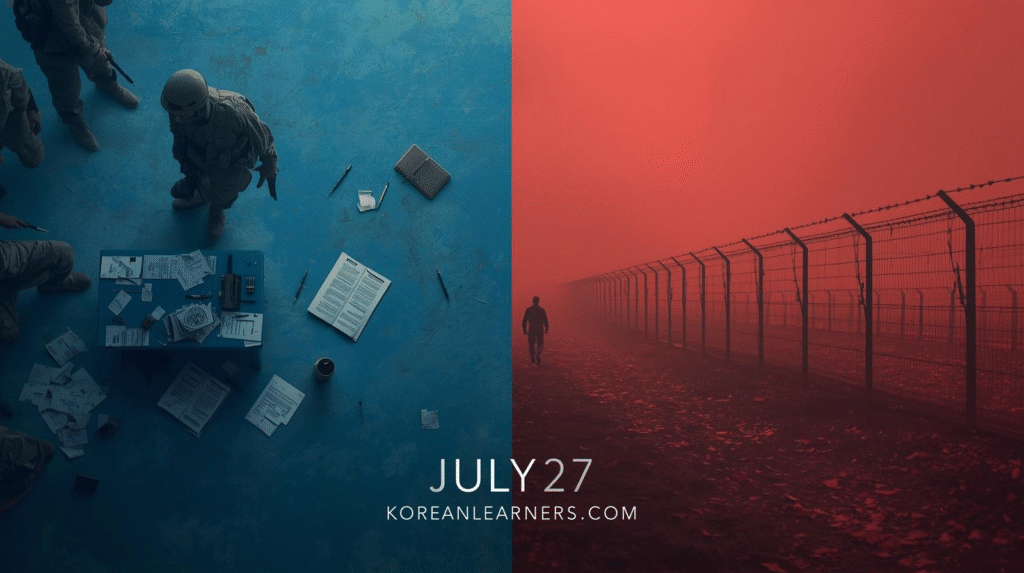
An armistice was eventually signed on July 27, 1953. However, this is where the narrative takes an unexpected turn. The deal was just a ceasefire and not a peace treaty. The war never truly ended, but the guns stopped firing. Instead, a 250-kilometer border known as the Demilitarized Zone, or DMZ, was established after the two sides decided to cease conflict. Families were split up and neighbors were made strangers by this strip of land that divided across the peninsula. Ironically, the DMZ became one of the world’s most heavily guarded borders despite being referred to as “demilitarized.”
The unspoken reality of July 27 is that it only created a pause, not peace. Even after seventy years, North and South Korea are still technically at war. The day is marked by a mixture of pride and sadness for South Koreans. It symbolizes survival and tenacity as well as the suffering of broken families. The same day is considered a victory in North Korea. Despite being one of the most significant dates of the Cold War era, it is frequently forgotten by the rest of the world.
The scale of the tragedy is evident from the numbers alone. In just three years, over three million people died, including soldiers from the US, China, Korea, and numerous other countries, as well as innumerable civilians who were forced to live through the chaos. In addition to uprooting families and destroying cities, the war left marks that continue to influence Korean society today. The Korean Peninsula is still divided today, and the effects of the conflict are still felt in world politics. This unresolved conflict can be linked to the tense relations between the North and its neighbors, the American forces positioned in South Korea, and even nuclear concerns.
Nevertheless, July 27 is also a day of hope despite the suffering. It serves as a reminder that even though the fighting has stopped, the narrative is still ongoing. The ceasefire may eventually become a real peace treaty, according to many, and the DMZ may change from being a wall to a bridge. July 27 is more than just a date on the calendar until that time arrives. It serves as a reminder of bravery and kindness, of families who have yet to be reunited, and of a conflict that came to an end but never really ended.
That is the reason why the war ended on July 27th, but peace never happened.
ARTICLE BY: VISHWA SHAH