

People often think of Korea as a place with amazing technology, K-pop, and cities that look like they belong in the future. But underneath this modern surface is something that has been around for a long time: superstitions (미신, misin). These old ideas are passed down from one generation to the next, and they affect how people act, what they say, and even how they joke around.
Younger Koreans might laugh at them, but many still follow these traditions quietly, “just in case.” Korean superstitions show a fascinating mix of practicality, symbolism, and cultural memory. They include things like numbers, food, dreams, and spirits.
1. Superstitions in Daily Life
Whistling at Night
People think that whistling at night will bring snakes or wandering spirits. Even now, older people tell kids not to whistle at night.
Shaking Your Legs
People in Korea often say, “If you shake your legs, your luck will leave.” People think that shaking drives away money and good luck.
Cutting Your Nails at Night
People used to think that cutting your nails at night was dangerous. According to old stories, mice could turn into spirits that looked like people if they ate the clippings.
Standing in Doorways
In Korea, doorways are thought of as the line between two worlds. People think that sitting or standing on them will bring bad luck or block good luck.
2. Numbers and Colors
Number 4 (사, sa)
Superstition (사, sa) is number four. 4 = 사 (sa) in Sino-Korean. In Chinese characters (死), the word for death is also 䂬 (sa). Many Koreans think that the number four is associated with bad luck or death energy because of this same pronunciation.You may not even be able to see the fourth floor in many elevators or buildings! The letter F (for “fourth”) is used in its place.
Red color
In Korea, the color red (빨강색) has two faces. It’s bright,and full of energy used in weddings, holidays, and lucky charms. But when it comes to writing someone’s name, red suddenly turns from a happy color to an ominous one.
In the past, Koreans used red ink to write the names of people who had passed away during funerals or memorials. It was believed that red ink could keep away evil spirits from the dead. Over time, however, it came to symbolize death itself.
So even today, if you write a living person’s name in red, people might gasp or quickly tell you to stop because it feels like wishing that person harm. Most Koreans stick to black or blue ink instead.
You might even hear someone gently say:
“이름을 빨간색으로 쓰면 안 돼요.”
(“Don’t write a name in red.”)
3. Food-Related Beliefs
Seaweed soup is traditionally consumed for health reasons on birthdays and after giving birth. However, because of its slick texture, which is believed to cause knowledge to “slip away,” students stay out of it before taking tests.
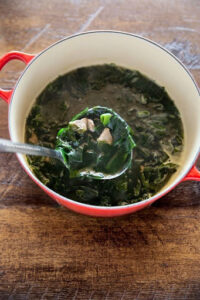 Credit : https://mykoreankitchen.com/korean-seaweed-soup-miyeok-guk/
Sticky Sweets Students eat rice cakes or sticky candy before tests in order for the information to “stick.”
Since chicken wings represent flying, lovers refrain from giving them to one another because they might cause the partner to “fly away” to someone else.
Chopsticks or a spoon in rice
Chopsticks left upright in rice are very unlucky and resemble funeral offerings.
4. Ghosts, Spirits, and Protection
Fan Death
According to a superstition that is specific to Korea, sleeping in a closed room with a fan running could result in death. In Korea, automatic timers are still included with fans as a “safety feature.”
White Dogs
White dogs are thought to ward off ghosts, protecting homes.The Sapsali, often called “Sapsalgae” is one of Korea’s most beloved traditional dog breeds. With its long, shaggy fur and gentle eyes, the Sapsali looks almost like a wise old spirit from the mountains.
 Credit : https://www.petguide.com/breeds/dog/sapsali/
In ancient times, Koreans believed that the Sapsali had the power to ward off ghosts and evil spirits. There’s even a famous saying: “No evils can come around where the Sapsali is.” Because of this belief, the dog became a symbol of protection, good fortune, and peace in the home.
5. Dreams and Omens
- Pigs in Dreams (돼지 꿈)
Dreaming of pigs is a symbol of wealth and prosperity. In the past, pigs were so valuable that they could be sold to pay university tuition. - Bird Calls
A magpie’s cry in the morning is believed to bring good news, while a crow’s cry signals bad luck.
6. Gift-Giving and Relationships
- Shoes as Gifts
Giving your partner shoes could make them “run away.” Couples often avoid this gift.
7. Animal Beliefs
- Butterflies and Eyes
Touching a butterfly and then touching your eyes is believed to cause blindness.
Shamanism, Confucianism, and folk traditions are the sources of many Korean superstitions. They served to prevent danger, promote gratitude for ancestors, and explain natural occurrences. They are still a part of cultural memory, even though most people today don’t take them literally.
Elevators without the number four and students munching on sticky candy prior to tests can still be found in contemporary Seoul. These beliefs are about a connection to one’s heritage, not just about fear.
Korean Vocabulary to Know
- 미신 (misin) – superstition
- 사 (sa) – number 4 / also means “death”
- 손이 없는 날 (soni eomneun nal) – “spirit-free day” (lucky moving day)
- 추석 (Chuseok) – harvest festival / ancestor rituals
- 죽음 (jug-eum) – death
- 행운 (haeng-un) – luck, good fortune
- 조상 (josang) – ancestors
- 돼지 꿈 (dwaeji kkum) – pig dream (lucky dream)
- 엿 (yeot) – sticky taffy candy
ARTICLE BY: VISHWA SHAH