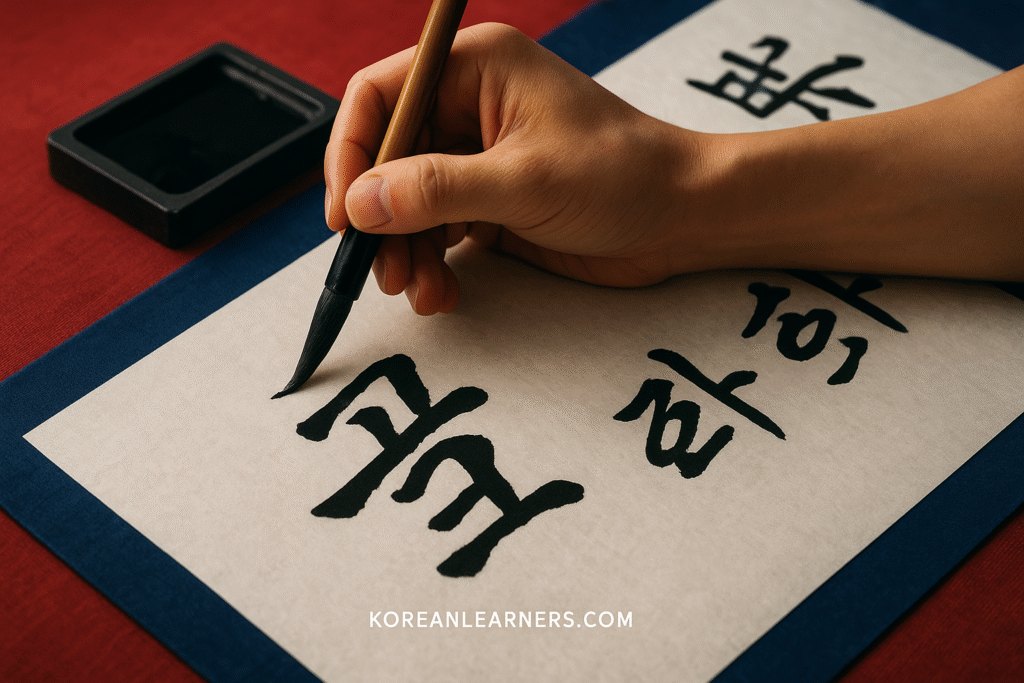

“Calligraphy” in Korean is called 서예 (seoye). From its Chinese origins, Korean calligraphy has developed over centuries into a unique artistic language that continues to influence modern artists as well as traditionalists.
From Hanja to Hangul: The Evolution of a Tradition
For a very long time, Koreans didn’t have their own easy way to write things down. About two thousand years ago, they borrowed the complex writing system from China, which we now call Hanja (Chinese characters). It was formal, it was respected, and they treated it like a serious spiritual art. They followed the Chinese masters for ages. Trying to copy their sophisticated, balanced styles.They eventually made the style a bit their own, often preferring a softer, more flowing look over the sharp, hard edges.
Everything changed in 1443 when King Sejong the Great gifted the nation Hangul. This new Korean alphabet was a stroke of genius: simple, logical, and easy for everyone to learn. It made mass literacy possible and perfectly matched the sounds of the Korean language. Yet, even after Hangul’s invention, Hanja continued to be used for formal calligraphy until the late 19th century. The gradual shift toward Hangul calligraphy opened a new chapter, one that celebrated simplicity, balance, and emotional depth through the shapes of native letters.
The Genius of Chusa: A True Korean Master
No discussion of Korean calligraphy is complete without Kim Jeong-hui (1786–1856), known by his pen name Chusa (추사). A scholar, philosopher, and artist during the late Joseon dynasty, Chusa was a genius who thought beyond tradition. He developed his own distinct style, Chusache (추사체). His art was deeply expressive, it looked like every powerful stroke carried an emotional weight. His philosophy was simple but profound: “Writing is painting the mind.” This idea remains central to understanding the spiritual power of Seoye today.
The Four Friends of the Study
Calligraphy relies on four simple tools, “the four friends of the study.”
- Brush
- Ink Stick Crafted from soot and glue, it is polished until solid.
- Ink Stone The stone where the ink stick is ground with water.
- Paper Traditional Korean paper, celebrated for its ability to absorb ink perfectly.
Calligraphy is regarded as a means of self-improvement in Korean culture. Artists characterize it as a powerful type of meditation that calms the mind, stabilizes the breath, and sharpens focus. The writer’s inner state is reflected directly in the brushstroke. A calm heart produces elegant, stable forms, a restless mind produces shaky, uneven lines.
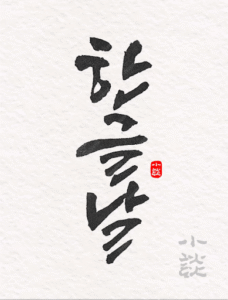
Even though keyboards and screens have taken over most of our writing, Korean calligraphy is far from fading away. It has simply evolved. Since the 20th century, artists have turned Hangul calligraphy into a modern visual art form.
The beauty of Hangul ( Korean Language Writing System) with its simple circles, lines, and balanced shapes continues to inspire today’s designers. You can see Seoye ( Korean Calligraphy) everywhere, in K-drama titles, brand logos, advertising posters, and even in home interiors where graceful brush strokes decorate walls and cafés.
For anyone visiting Korea, this art isn’t hard to find. At places like Namsan Hanok Village or local community centers, you can join calligraphy workshops and try the brush yourself. Many people describe it as a calming, mindful experience.
I experienced this firsthand just a few days ago when I took a Seoye workshop. Beyond just holding the brush, I learned about the three main classical styles. Gungche, also called the palace style, was originally used by women of the royal court. It is known for its graceful and elegant look. Haengche, the semi-cursive style, reflects the writing of scholars, combining formality with a natural flow. Minche, or the folk style, is simple and expressive, inspired by the handwriting of everyday people. Each style shows a different side of Korea’s beautiful calligraphic tradition.
Whether used for a powerful K-drama title or for a personal moment of meditation, Korean calligraphy remains a living art.
ARTICLE BY: VISHWA SHAH