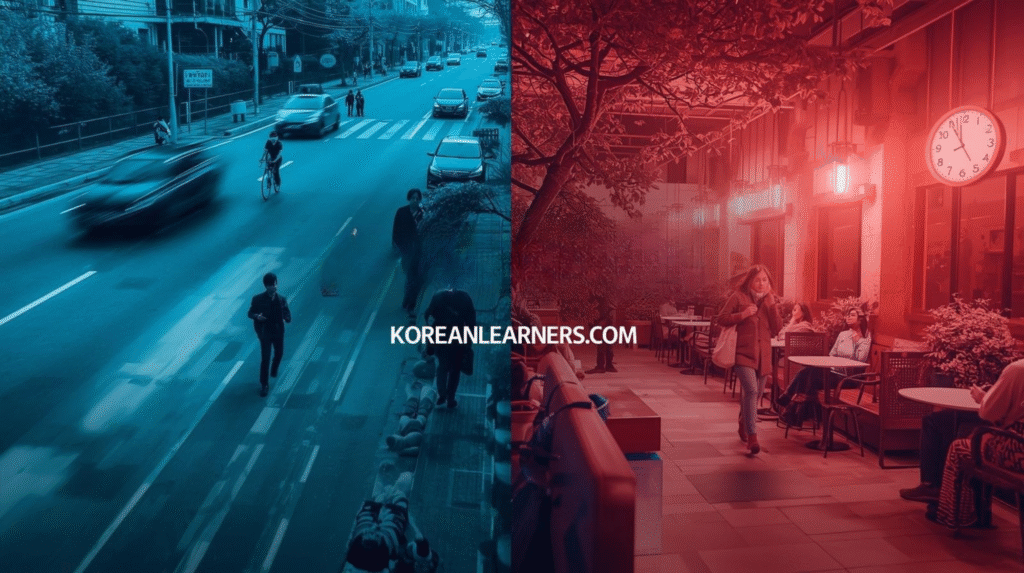

‘ 빨리 빨리 ‘ (ppalli ppalli ) is a well known Korean phrase meaning ” quickly – quickly, or hurry up ” , that reflects a cultural urgency in South Korea to value speed , efficiency and promptness in daily life , while the 힐링 문화 ( healing culture) refers to a growing cultural trend in Korea that focuses on the well being of a person .
Origin And Meaning
빨리 빨리 문화
The origin of the 빨리 빨리 dates back to the Korean war and it became the core engine of South Korea’s ceased growth since the 1960s .
This sense of urgency with efficiency played a crucial role in South Korea’s rapid industrialization (Miracle on the Han River ) , helping it become a global economic powerhouse with companies like Samsung , LG , Hyundai , with a world class fast paced internet .
힐링 문화
Healing culture is getting popular among young people as a counter mechanism to 빨리 빨리 . It emerged in response to societal stress , burnout , and the high competition rate in today’s time . By constantly being in a high pressure environment where no one wants to stay behind the other led to increasing interest in healing and mental wellness .
Fun And Surprising Facts
빨리 빨리 – There is high economic growth, technological advancement , convenience with more awareness about the value of time , punctuality and civic sense .
~ Quick and convenient public commute , ultra – fast food service /delivery , rapid decision making in meetings because of the sense of urgency and time management with widespread impatience that is leading the world with its high paced economic growth.
~ There is increasing trend of overnight success amount young people .
힐링 문화 – An active lifestyle where individuals seek their own form of peace to promote self-care , psychological well-being & solace in solitude .
~ 힐링( healing culture ) is Meong Ttaerigi ( 멍때리기 )
‘ the act of spacing out ‘.
~ Activities like 불멍 Bulmeong ( staring blankly at a fire )
물멍Mulmeong ( staring blankly at water ) , 숲멍 Supmeong ( staring blankly at forest ) , became a common practice among people that provide true peace to the body and mind .
~ An annual ” Han River space out competition ” is held where people just sit in silence and do nothing .
~ Activities like these reflect a deep desire of modern people to break free from the compulsion of always being productive.
~ The Jjimjilbang ( 찜질방) , a traditional Korean bathhouse also became a healing destination.
~ After being in Sauna ( hot heated room ) for too long , is followed by a cold bowl of Sikhye 식혜 ( a sweet rice beverage ) or Banana milk ( 바나나 우유) .
~ Temple stays , going on trails , spending time in water streams for refreshment became a popular and trending part of healing culture .
Modern Changes
The 빨리 빨리 spirit is etched into the DNA of Korean society and its probably not going to disappear overnight . But this quick culture spirit is what brought South Korea’s economy this far . From a poor country who suffered for basic necessities to becoming a cyberhub , South Korea’s resilience , perseverance, efficiency was and still the key factor behind all of the achievements.
However , the growing interest in ‘ Healing ‘ shows that people are learning to balance between the two culture , which is very important in today’s time.
Final Thoughts
The mindset and determination to rebuild & develop rapidly deeply rooted in every korean citizen .
~ 빨라 빨리 (Quick Quick ) – A cultural mindset valuing efficiency and speed for better productivity .
~ 힐링 문화 ( Healing Culture) – A cultural trend promoting relaxation and mental wellness .
Both coexist in modern Korean society , reflecting the dynamic balance between fast paced development and the need for personal healing .
Have you ever been to a Jjimjilbang ( 찜질방) , or tried any of these healing trends ?