


Do you want to quickly learn the Korean alphabet? Hangul, the Korean alphabet, is made up of 24 characters (10 vowels and 14 consonants) organized into syllable blocks that make up words. King Sejong invented Hangul in the fifteenth century to simplify reading and writing for the average person. With a little practice, you can master Hangul in just a few hours. In easy-to understand language, this guide will teach you basic information
What Is Hangul?
The Korean language is written using the Korean script, Hangul. The Chinese character is the source of the word (Hangul). “Gul” means “letter” or “script”, and “han” means “Korean”. When you combine these, you obtain the phrase “Korean script” or “Korean Alphabet”. In South Korea, it’s called Hangul or Hangeul.
Basic Korean Consonants (14 Characters)
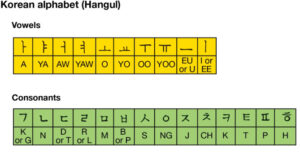
Korean consonants, which are represented by unique alphabet symbols in the Korean writing system, are simple sounds produced by stopping or creating airflow with your mouth. They are combined with vowels to form syllables. These consonants create the structure of each syllable, control how words are pronounced, and work along with vowels to make unique easy-to-read sound units. They are an essential component of learning to read and speak the Korean language.
|
Basic Korean Vowels (10 Characters)
The Korean vowel system consists of 10 basic vowels that combine to form 11 complex vowel combinations used for syllable pronunciation. Unlike English vowels, which have multiple pronunciations, Hangul vowels have consistent sounds, simplifying pronunciation for learners of the Korean language.
| Hangul | English Sound | Pronunciation Guide | Notes |
| ㅏ | a | ah (like in father) | Vertical stroke |
| ㅑ | ya | yah | Vertical stroke + two short dashes |
| ㅓ | eo | uh/aw (mix of ‘cup’ + ‘saw’) | Vertical stroke + dash to the left |
| ㅕ | yeo | yuh/yaw | Vertical stroke + two dashes to the left |
| ㅗ | o | oh (like ‘boat’) | Horizontal stroke + dash above |
| ㅛ | yo | yoh | Horizontal stroke + two dashes above |
| ㅜ | u | oo (like ‘moon’) | Horizontal stroke + dash below |
| ㅠ | yu | yoo | Horizontal stroke + two dashes below |
| ㅡ | eu | eu/euh (like ‘uh’ with lips flat) | Flat horizontal line |
| ㅣ | i | ee (like ‘ski’) | Vertical straight line |
What Is Batchim?
In the Korean writing system, Batchim is the final consonant at the bottom of a syllable block in Hangul. Each syllable generally includes a vowel and at least one consonant, with some also containing a final consonant called batchim.
| Rule | What Happens | Letters | English Explanation |
| 1. Basic Final Sounds | Batchim keeps its simple final sound | ㄱ=k, ㄴ=n, ㄹ=l, ㅁ=m, ㅂ=p | End sounds are soft and short |
| 2. T-Sound Rule | Many batchim become t | Final consonants that turn into “t”: ㅅ, ㅆ, ㅈ, ㅊ, ㅌ, ㅎ | These letters all lose their original sound at the end and become one single sound: a light t. |
| 3. Linking to Vowel | Batchim moves to next syllable if next block starts with a vowel | Any final consonant + vowel | The final consonant moves forward and links to the next vowel, like “big apple” sounding like “bi-gap-ple.” |
| 4. Nasalization (Nose Sound) | Sounds change to n / m / ng when near ㄴ or ㅁ | ㄱ→ㅇ, ㅂ→ㅁ, ㄷ→ㄴ | Becomes softer/nasal |
| 5. Silent ㅎ Rule | ㅎ weakens or disappears | ㅎ + (other consonant) | Sound becomes lighter or aspirated |
Consonant Mnemonics
- ㄱ looks like a gun → g/k
- ㄴ looks like a bent knee → n
- ㅁ looks like a mouth → m
- ㅅ looks like a seed sprout → s
- ㅇ looks like an open mouth saying nothing → silent
Vowel Mnemonics
Hangul vowels are based on direction + stroke
- Stroke on the right (ㅏ) → “aah”
- Stroke on the left (ㅓ) → “uh”
- Dash above (ㅗ) → lips go up → “oh”
- Dash below (ㅜ) → lips go down → “oo”
Pronunciation Hacks
- Words never end with strong sounds. A final k, t, p, m, n, ng, l is soft and short. Just close your mouth quickly and stop.
- When you see a consonant written twice (like kk, pp, tt), just add tension, not volume.
- When two vowels appear side-by-side, they blend smoothly. (“ya” like y + ah, “wa” like w + ah)
- There is no pure R and no pure L. It’s a soft sound made with the tongue lightly touching the roof of your mouth.
- When an s comes before an “ee” like a vowel, it becomes sh automatically. So, “si” sounds like shee not “see”.
- If a word ends with a consonant and the next begins with a vowel, the consonant “jumps” to the next word and sounds like it starts here. (“pick it”- “pi-kit”)