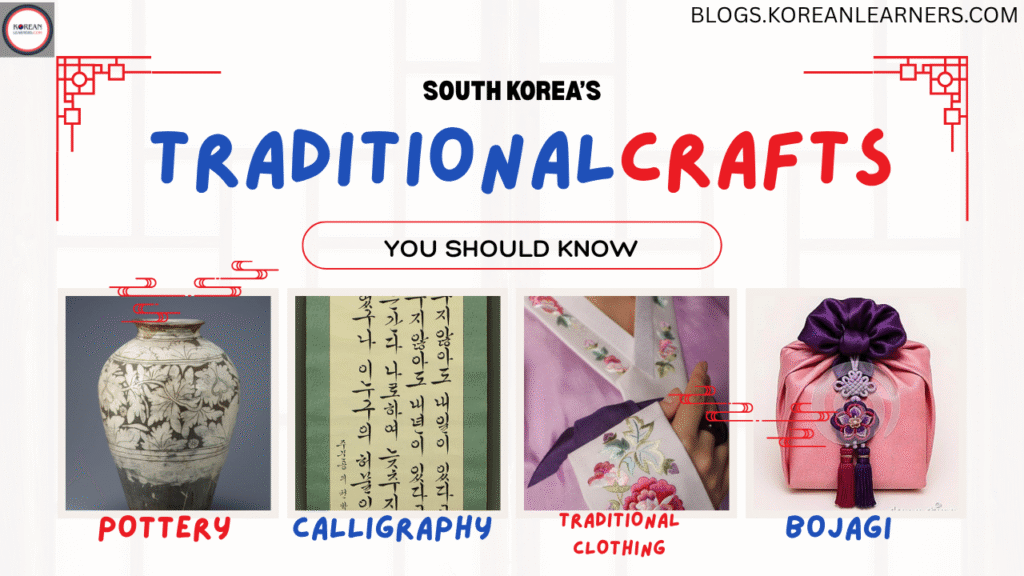

Korea has made a special place in our hearts. Sure, K-pop has opened the door to our curiosity. Its traditional crafts carry centuries of skill, stories, and symbolism. From the elegance of Gugak (Korea’s classical music and dance) to the precision of painting and calligraphy, every art form feels calming, almost meditative.
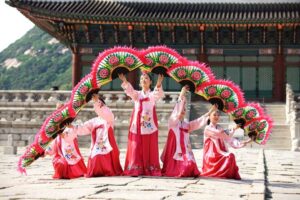
Image source – South Korea Facts and History
Korean Traditional Crafts:
Korean craft is an inseparable part of the rich history of Korea. Influenced by natural materials and the country’s cultural values, Korean artisans developed unique techniques and styles that were passed down through generations. Many of these crafts were primarily made for daily utility, such as utensils, clothing, and home decor. Over time, these crafts have evolved into highly regarded art forms that continue to reflect Korean identity and cultural pride.
Pottery:
Pottery in Korea nowadays is one of the favorite attractions. It is mainly divided into 3 main types: Cheongja (blue-green celadon), Buncheong (slip-coated stoneware), and Baekja (white porcelain).
Cheongja is a jade stone that was used to make stone utensils around 700-1000 years ago. The unique glaze on these pots was achieved under a high-firing process.
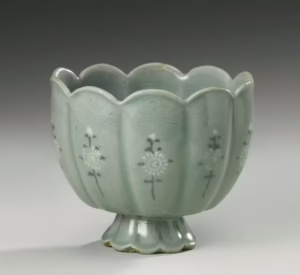
Image source – 5 Facts to Know About Korean Celadon | Barnebys Magazine
Buncheong is quite similar to Cheongja in how it’s made. It’s also made out of stone, but the only differentiating factor here is that the stone, after heating, is dipped in a white slip to give it a finishing touch.
Baekja, a pot made out of fine white type of clay, which turns glossy under heat.
While many Korean crafts now offer online classes, pottery is the one exception. Traditional Korean ceramics usually require studio tools and firing facilities, so most workshops are still conducted in person.
Mother-of-pearl inlay:
It’s the ancient craft of Korea, where the mother-of-pearl is the shiny layer found inside the shell. Korean artisans take thin pieces of that shiny shell, cut them into shapes, and embed them into wood or lacquered surfaces to create decorative patterns. That embedding process is what “inlay” means.
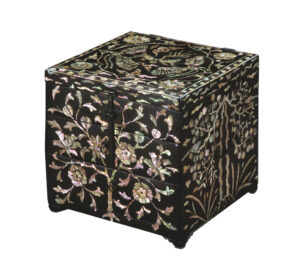
Image source –National Museum of Korea Quarterly Magazine
Mother-of-pearl inlay is still taught mostly through in-person workshops in Korea. Because the craft involves delicate tools, lacquer, and shell materials that are hard to ship, there aren’t any widely available online classes yet.
Calligraphy:
Korean calligraphy is the art of writing Hangul with intention and skill. Every stroke matters. The brush, ink, and paper work together to create something that’s both visually and emotionally engaging.
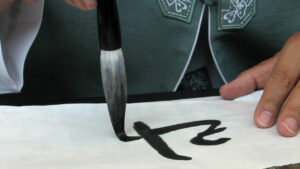
Image source – Korean calligraphy
Although calligraphy stands on its own, it’s closely connected to ink-and-wash painting because both use the same essential tools, often called the Four Treasures of the Study. Korea has a long lineage of master calligraphers, but Kim Jeong-hui (Chusa) is one of the most celebrated. His Chusa style is still admired for its modern, expressive character.
If you want to explore this art yourself, the King Sejong Institute Foundation hosts online calligraphy workshops you can join.
Korean hand embroidery:
If you are a Korean drama fan, you might have adored the beautiful, extraordinary embroidery on display. Korean traditional embroidery has a history of more than 2,000 years. Since prehistoric times, the need for sewing led ancient Koreans to use needles made from fish or other animal bones to weave animal skin, tree bark, and leaves.
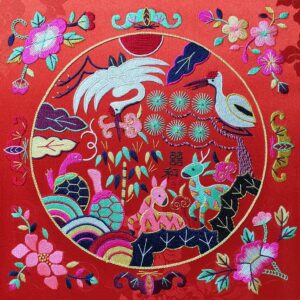
Image source – World Embroidery Series III: Korean Embroidery – Tatter
However, in the current era of sewing machines and industrialised textile manufacture, it is hard not to marvel at the exquisite patterns of silk flowers and animals that traditionally were sewn into ceremonial items of clothing, such as the hwalot (bridal robe), by hand.
And now you can learn this beautiful art from the comfort of your home. Below is the link to the online workshop for Korean traditional embroidery.
Link – Needle painting drawn with embroidery thread | Kazuki Hasegawa
Traditional Korean wrapping cloth (Bojagi):
A simple-looking cloth made out of patchwork holds emotions for Koreans. Bojagi is the traditional wrapping cloth used to wrap items for transport or storage, to cover food, and even to protect precious goods.
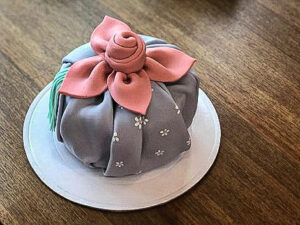
Image source – https://www.cover.earth/uncover/the-ultimate-guide-to-bojagi
Bojagi is of two types, one in solid silk cloth and the other made out of sewing multiple patches together. It has a strong cultural meaning: wrapping something with care is a sign of respect and good wishes.
You don’t need much equipment: just fabric, a needle, thread, and basic instructions. This makes it one of the easiest Korean heritage crafts to learn at home.
Giving it a try will surely make you fall in love with this art.
Link – Bojagi by Hand: Basic Sewing 1 | “Creative Sewing Techniques: Introduction to Bojagi” (desedamas)
https://www.korea.net/Events/Overseas/view?articleId=14005&utm_source=chatgpt.com
Korean Traditional Knotting:
The Korean knot is a traditional Korean handicraft that is made using one or more threads. Korean knots have a unique braiding technique and are tied mainly without the use of tools. In the past, knots were used to carry tools for hunting, communication, and records, or as a symbol of social status.
But later, it became a form of art employed in ornamental creations. The Korean knots can be used to make various items that include identity tags, key-rings/holders, necklaces, bracelets, and other items.
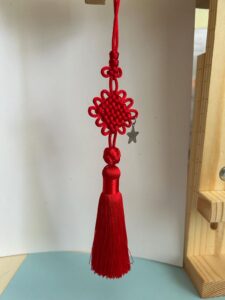
Image source – Korean Maedup Knot Bag Charm, K-pop Inspired Norigae – Etsy in 2025 | Etsy, Crafts, Timeless meaning
Because the technique doesn’t rely on tools, learning it feels hands-on and meditative. With a bit of practice, you can create keychains, bracelets, necklaces, or decorative charms.
Link – https://hk.korean-culture.org/en/938/board/1048/read/111470
Korean craft always reminds me that beauty is born from patience, repetition, and the quiet pride of making something by hand. Whether it’s the glow of celadon, the shimmer of mother-of-pearl, or the soft geometry of a Bojagi wrap, each craft carries a piece of Korea’s history and heart.
If you’ve fallen in love with Korea through music or dramas, exploring these traditional arts is the next step that deepens that connection. And the best part? Many of them are now easy to learn from home. Let us know which craft you’ll try your hand at first.
Article by: Mudita
Edit by: Aparna Dubey
Ref –