
The “K-Dream” Roadmap: How to Crack the GKS Scholarship for Indian Students (Without Losing Your Mind)
So, you’ve watched enough K-dramas to know that eating Ramyeon by the Han River is a vibe, or maybe you’re legitimately obsessed with South Korea’s tech and engineering prowess. Either way, you want to study there. But there’s a catch: studying abroad costs a fortune.
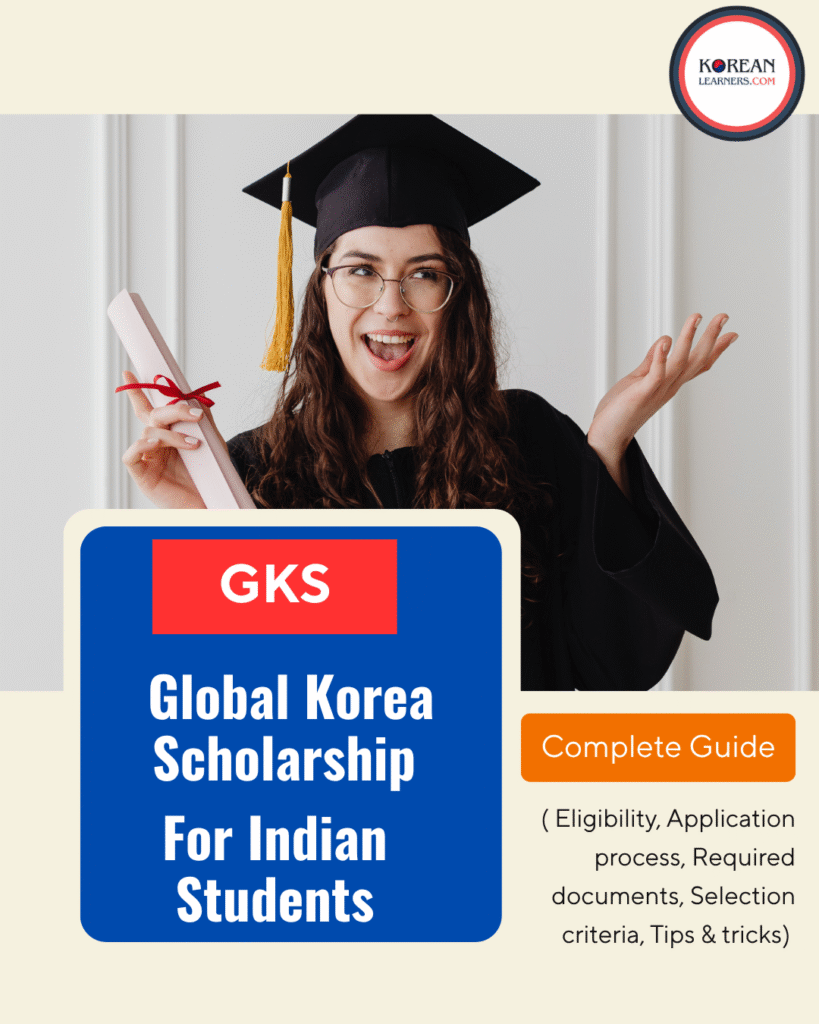
Enter the Global Korea Scholarship (GKS).
Formerly known as KGSP, this is the “Holy Grail” of scholarships. We are talking full tuition, a monthly allowance (so you can actually buy that Ramyeon), flight tickets, and even medical insurance. It is fully funded.
But here is the reality check: It is the Hunger Games of scholarships. The competition in India is fierce.
If you want to win, you need to stop acting like a regular applicant and start thinking like a strategist. Here is your battle plan for the 2025-2026 cycles.
- The Vibe Check: Are You Eligible?
Before we get into the paperwork mountain, let’s make sure the door is actually open for you. The National Institute for International Education (NIIED) has strict bouncers at the gate.
The “Hard” No’s:
- Citizenship: You and your parents must be Indian. If one of you holds a Korean passport, you’re out.
- Health: You need to be fit enough to survive graduate school (which is stressful enough).
- The “Double Dipping” Rule: If you already got a degree scholarship from the Korean government before, you usually can’t apply again (unless you had a GPA over 90%, in which case, you’re a genius and you know it).
The Age & Degree Limits:
- Undergraduate (UG): You must be under 25. You need 12th-grade completion (10+2).
- Graduate (Masters/PhD): You must be under 40. You need a Bachelor’s (for Masters) or a Master’s (for PhD).
The Grade Cutoff (The 80% Rule):
You cannot just pass; you need to be good. Your previous degree GPA must be:
- Over 80% percentages.
- OR ranked in the top 20% of your class.
- OR have a CGPA better than 2.64/4.0.
Pro Tip for Indians: If your college transcript says “7.5 CGPA” but doesn’t explain what that equals in percentage, NIIED will get confused and toss your application. Get a conversion certificate from your university registrar. Do not let math be the reason you get rejected.
- Choose Your Fighter: Embassy Track vs. University Track
You have two ways to enter the arena. You can only pick one. If you apply to both, you are immediately disqualified.
Option A: The Embassy Track (The Safety Net)
- How it works: You send your documents to the Korean Embassy in New Delhi.
- The Perk: You get to apply to 3 different universities. If University A says no, University B might say yes. It’s safer.
- The Vibe: It’s a longer process (3 rounds of selection), but you have backup options.
- Quota for India: Usually around 22-25 students.
Option B: The University Track (The Sniper)
- How it works: You send your documents directly to ONE Korean university.
- The Perk: It’s faster. If a professor there likes you, you’re essentially in.
- The Risk: You put all your eggs in one basket. If they reject you, it’s game over for the year.
- Quota for India: Usually around 25-30 students.
Which one to pick?
If you have a mediocre GPA (near the 80% cutoff), go University Track but pick a less famous university. If you have a stellar profile (90%+ and TOPIK scores), go Embassy Track to aim for the big “SKY” universities (Seoul National, Korea, Yonsei).
- The Paperwork Mountain (And the “Apostille” Headache)
This is the part where most Indian students give up. Don’t be them.
South Korea takes paperwork seriously. You can’t just send a photocopy of your degree. You need your documents Apostille.
What on earth is an Apostille?
It’s an international verification sticker that says, “This document is real.” Since India and Korea are both part of the Hague Convention, you need this.
The Indian Apostille Route:
- Notary: Go to a local advocate. They stamp your photocopy.
- SDM Attestation: The Sub-Divisional Magistrate verifies it (do this in Delhi for speed).
- MEA Apostille: The Ministry of External Affairs sticks a square sticker on the back.
Warning: You cannot walk into the Ministry of External Affairs. You have to use outsourced agencies (like VFS, BLS, or Superb Enterprises). It costs money (approx ₹500-₹800 per page), so budget for this!
The “Must-Have” List:
- Application Form (Type it! Do not handwrite it unless you want them to squint).
- Personal Statement (SOP).
- Study Plan (Goal setting).
- One Letter of Recommendation (Make sure your professor actually likes you).
- Proof of Citizenship: Your Passport + Parents’ Passport (or Aadhaar/Voter ID if translated and notarized).
- Degrees & Transcripts: Apostille.
- How to Actually Win (Selection Criteria & Hacks)
Okay, everyone has good grades. How do you stand out?
- The “Why Korea?” Trap
Boring Application: “I love K-pop and Kimchi. I want to meet BTS.”
Winning Application: “I am interested in South Korea’s rapid industrialization model (Miracle on the Han River) and how I can apply those supply-chain efficiencies to India’s developing textile market.”
See the difference? Connect your major to Korea’s strengths. Make them feel like investing in you will help diplomatic relations between India and Korea.
- The Language Cheat Code
If you have a TOPIK (Test of Proficiency in Korean) score, you are basically royalty.
- A TOPIK Level 3 certificate gives you 10% bonus points on your evaluation. In a competitive field, 10% is massive.
- Even if you don’t have a certificate, mention in your SOP that you are self-learning Hangul. It shows effort.
- The “Regional University” Hack (Type B)
In the Embassy track, you have to pick 3 universities. You are forced to pick at least one “Type B” (Regional) university (schools outside Seoul).
- The Hack: Most Indians are obsessed with living in Seoul. Consequently, Regional Universities (like Pusan National, Chonnam National, etc.) get fewer Indian applicants. If you list a strong Regional University as your #1 choice, they might snatch you up immediately because they are hungry for international talent.
- The Timeline: When to Panic
For Undergraduates (Bachelors):
- Announcement: September.
- Deadline: Early October.
- Fly to Korea: Late February.
For Graduates (Masters/PhD):
- Announcement: February.
- Deadline: Early March.
- Fly to Korea: Late August.
Note: The Indian Embassy in Delhi sets its own deadline, which is usually earlier than the official NIIED deadline. Check the Embassy website daily during these months.
- Final Tips from a “Sunbae” (Senior)
- Don’t wait for the announcement: The window between the announcement and the deadline is barely 3 weeks. The Apostille process in India takes 2 weeks. Do the math. Get your documents ready now.
- English Proficiency: While not mandatory, attaching an IELTS or TOEFL score helps. It proves you can survive the English-taught classes while you are learning Korean.
- Clean up your Social Media: Okay, they probably won’t check, but this is a government scholarship. Maybe archive those wild party photos for a bit.
- The Medical Check: You have to sign a paper saying you are healthy. If you pass the final round, you have to do a real medical test. If you test positive for drugs, you are on the next flight home.
Summary
The GKS scholarship is a life-changing experience. You get a year of free language training (Language Year) plus your degree. You will make friends from 150 different countries. It is hard work to apply, but a debt-free degree is worth a few weeks of paperwork stress.
So, stop scrolling, go find your original mark sheets, and start drafting that SOP!